
Deus Ludens
Jeff Jones on Keith McDonald - the ultimate cheat code

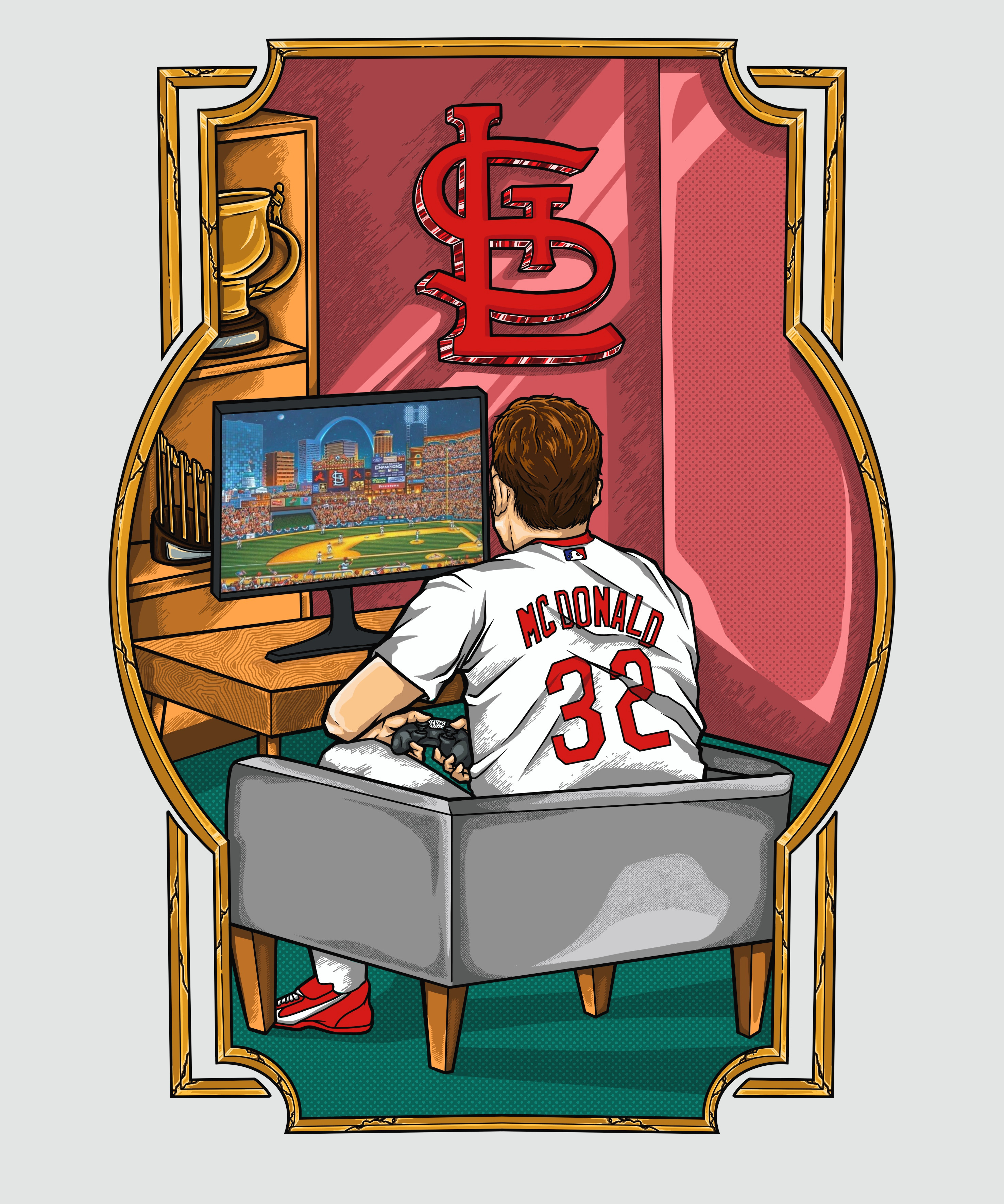
By Jeff Jones
If it’s true that the current generation of baseball fans grew up wanting to be general managers rather than players, then an underlying cause of that desire must be video games as much as fantasy sports. In 2000, I was only vaguely aware of fantasy baseball by virtue of having gotten my hands on an old rotisserie draft guide that read to me as a book of statistics with mysterious dollar values attached to each player. I figured the $1 guys must not be very good, but didn’t consider it much beyond that.
What I had, though, was access to the family Gateway computer and an overstuffed zippered pouch full of games on CD-ROM. Triple Play 99 was one of those games, and since you could trade players and shuffle rosters around, I was hooked. These were my guys, and I could make them any guys I wanted.
When Keith McDonald showed up in St. Louis on Fourth of July in 2000 and hammered a homer in his first big league at bat, I was interested. When he hit another in his first start two days later, I decided he was…Javy Lopez? Mike Piazza? Whoever he was, he was much more interesting than Mike Matheny, who made for a very boring video game guy.
Could Matheny handle a pitching staff in ways I did not properly appreciate at 13? Probably so. Did that enhance my dinger mashing experience? It absolutely did not. So off he virtually went, and by the time McDonald had his third homer in seven at bats, he was ensconced in the middle of my lineup right behind Mark McGwire.
Prospect coverage in 2000 hadn’t reached anything like the saturation point it has today. When players reached the big leagues, especially from the perspective of someone my age, it was like they’d materialized out of thin air. The only exception seemed to be JD Drew, who I understood at the time to have done something bad about money, and anyway Scott Boras was ruining baseball, and aren’t those people in Philadelphia mean?
Never mind that McDonald was 27 by the time he reached the big leagues, having attended three colleges and having been drafted twice. Never mind that prior to his debut, he’d never even hit double digit homers in a minor league season. He scarcely even qualified as the starting catcher for Memphis at the time he was called up, but Steve Bieser and Rick Wilkins were in their 30s, Eli Marrero hurt his thumb, and the call was bound to come for someone.
I also didn’t know at the time that McDonald was the second Cardinal ever to have been born in Japan, following Bobby Fenwick’s six plate appearances in 1973. He was also the second person to ever hit two home runs in their first two big league plate appearances, joining St. Louis Browns outfielder Bob Nieman. If I had known there were two, perhaps McDonald wouldn’t have gotten the max out of his power slider on his create-a-player model.
He’s not the only local athlete who received the video game treatment in my house. A Russian winger named Konstantin Shafranov popped up for the St. Louis Blues in 1997 and scored twice in five games; for months after, he played on a line with Brett Hull and Pierre Turgeon on my Sega Genesis.
The act of literally creating digital players from nothing seemed to only reinforce the belief that somehow the minor leagues were something unreachable and unknowable. There were of course prospect rankings even as early as 2000, and undoubtedly some of those were published online. There were almost certainly also downloadable rosters and modifications for video games that would’ve slotted McDonald into his proper rankings rather than putting him firmly in the Jon Dowd Zone. I didn’t care. He hit homers in real life, so he was going to hit homers on my computer.
McDonald didn’t record a hit in two plate appearances in 2001 and spent his last five seasons bouncing between five organizations in Triple-A. His three homers are still the most recorded in major league history by anyone with 11 or fewer plate appearances. Those cutoffs are arbitrary, but so is baseball. Let the guy have his club to himself, I say.
For a couple of months in the summer of 2000, he was the greatest video game catcher anyone had ever seen. Plenty of guys grind out long careers in baseball and never reach those heights. Twenty-five years ago, they felt just as real to me as anything he ever did on the way to get there.
Jeff Jones has covered the Cardinals for the Belleville News-Democrat since 2019. His work has also appeared in Sports Illustrated and on MLB.com.