
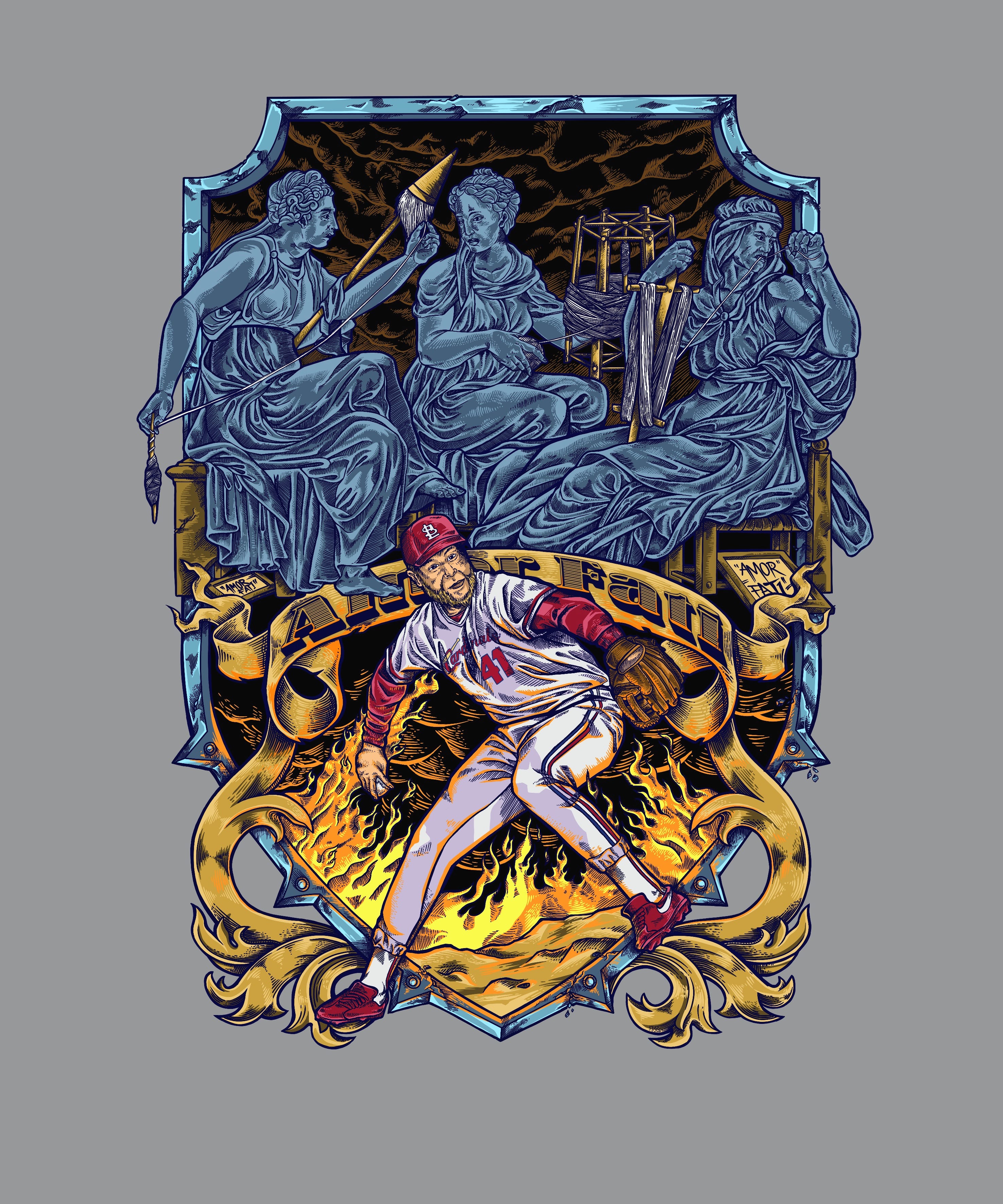
Amor Fati
Doug Feldmann on Tom Niedenfuer and how the fates can be so cruel

By Doug Feldmann
During a game at Dodger Stadium in Los Angeles in 1985, ballpark officials had advised fans sitting along the left field line not to lean against the makeshift wall which was temporarily installed while permanent repairs were progressing. The warning was not heeded; and throughout the night, the barrier collapsed not once but twice. As the fans tumbled onto the playing field for a second time, legendary broadcaster Vin Scully remarked that “the walls of Jericho have come tumbling down again” – a fitting prelude to what would be a back-to-back implosion of one of manager Tommy Lasorda’s most trusted relievers.
From a small Minnesota town, unfortunately named St. Louis Park, Tom Niedenfuer entered the 1985 National League Championship Series against the St. Louis Cardinals in October with something to prove. A dominant August for Niedenfuer (0.48 ERA) had given way to a woeful September (6.10 ERA), as he dropped five of six decisions out of the bullpen to close the regular season. Yet, as Lasorda’s men prepped for their pursuit of the pennant, there was little concern that Niedenfuer's slump would continue. Over four playoff appearances for the Dodgers in 1981 and 1983, he had permitted no runs and saved Game Two of the ’83 NLCS against the Philadelphia Phillies in Dodger Stadium.
Niedenfuer’s playoff excellence appeared to have carried over into 1985. In the first Championship Series game against the Cardinals, he authored two and two-thirds innings of stellar relief in saving Game One for starter Fernando Valenzuela in Chavez Ravine. The performance gave Los Angeles an early advantage for a World Series trip and left Niedenfuer having yet to be scored upon in postseason action in his career.
With the series tied at two games apiece, Niedenfuer was again called upon to replace Valenzuela on the hill, this time in the cookie cutter of old Busch Stadium. The righthander’s dominance continued, as he induced leadoff hitter Willie McGee to pop meekly in foul ground to third baseman Bill Madlock.
Following McGee was Ozzie Smith, who was 0-for-2 with a walk on the afternoon. After the Wizard fouled the first two pitches back over the screen to put himself in a two-strike hole, he drew a deep breath and took a practice swing in the batter’s box as the television broadcast displayed an interesting fact under the shortstop’s name for the viewers: “Has not homered batting lefty in 2,967 career at bats.”
In the Los Angeles dugout, Lasorda’s assistant coach Joey Amalfitano got the attention of the Dodger outfielders. He pointed both of his index fingers to the ground, which directed them to move further in with Smith likely to be swinging defensively with two strikes.
Another pitch went outside for a ball. But with a U-shaped whip of his bat, Smith floated the next offering skyward toward the right field bleachers for a game-winning home run and thus launching one of the iconic calls of announcer Jack Buck’s career – no small feat in itself. The blast put the Cards up three games to two in the series as the Busch Stadium scoreboard declared “California, here we come.”
After an off-day for travel, the teams met in L.A. for Game Six as the Dodgers leapt out to a 4-3 lead in the seventh inning. With McGee on first, Lasorda again turned to Niedenfuer, this time in relief of Orel Hershiser. As the TV broadcast returned from a commercial, waiting on deck was Ozzie. Niedenfuer had the chance to prove that their last matchup was a fluke, but the Wizard struck again, driving a triple into the right field corner, tying the game.
Niedenfuer retired the Cardinals in order in the eighth and the Dodgers repaid their reliever's fortitude by retaking the lead in the home half of the eighth, 5-4. In the ninth Lasorda stayed with Niedenfuer, who permitted McGee and Smith to reach again respectively on a single and a walk but was able to mix in two outs. With their fans standing and hollering, the Dodgers were one batter away from forcing a decisive seventh game as catcher Mike Scioscia visited the mound for a lengthy talk with Niedenfuer.
Due up was Jack Clark, the Cardinals’ lone power source who had nonetheless failed to homer in the series and had posted only one dinger since returning in the third week of August from an injury. First base was open, prompting Lasorda to pace the dugout while Clark dug into the batter’s box and rhetorically asked his bench, “Should I walk him and pitch to that [expletive] Van Slyke?” He did not and Clark wasted no time in making Lasorda second guess himself, unleashing his long-but-blistering swing on the first pitch as the bat recoiled back to the ground nearly as fast as it had swung forward. The ball rocketed into the left stands to instantly put the Cards in the lead. As one television camera caught a red-faced Niedenfuer resembling Yosemite Sam being foiled again by Bugs Bunny, another captured Lasorda on the home bench as he removed his cap, lowered his head, and rubbed his scalp – all in an effort to conceal his expletives from the national audience. As Clark trotted down the first base line, he looked back at his Cardinal teammates and mouthed a triumphant “THAT’S A BIG FLY, BI___CHES!” Like an over-excited college team they were all there at the plate to meet the slugger, in perhaps the only time in St. Louis history that a home run hitter was mobbed at the plate before the game was over. “You would think that the fates would be a little kinder to one man in such a short amount of time.” Scully commiserated as the TV audience watched the replay of Clark's blast.
Lefty reliever Ken Dayley downed the demoralized Dodgers in order in the bottom of the ninth, and the Redbirds owned their fourteenth National League pennant.
For his part, Niedenfuer would leave the Dodgers in 1987 for stops in Baltimore and Seattle before ironically finishing his career with one year in Busch Stadium in 1990, posting a serviceable season out the bullpen (despite an 0-6 record) amidst the Whitey Herzog-Red Schoendienst-Joe Torre transition of managers. Herzog quipped at the time that it was the least the team could do for Niedenfuer, after everything he had done for them.
He started the season at the Cardinals’ AAA affiliate in Louisville, but was in St. Louis with the big league club by the end of April. Niedenfuer had a very respectable year for the 1990 Cardinals. He struck out 65 batters in 66 IP and notwithstanding a 0-6 record, he had an ERA+ of 110 and earned 10 holds. Yet despite his serviceable year for a bad team, Niedenfeur was not resigned by the Cardinals in 1991, nor any other team.
How could the fates have been so cruel to Niedenfuer that singular autumn? Only conjecture can estimate the chances of Smith’s and Clark’s home runs being surrendered by one pitcher in the context in which they occurred. For his part, Niedenfuer took his ignominious place in Cardinals' history in stride: "What can you do? It happened,” Niedenfuer said in a 2010 interview on the 25th Anniversary of the Smith and Clark homeruns. “Looking back on it,” he continued, “It’s a very proud feeling that your manager had enough confidence in you to be the guy he put in that situation. I wouldn’t trade that for anything in the world because I loved being out there.” Yet, in any event – as with the Denkingers, the Northrups, the Hrbeks, and a handful of others – Niedenfuer will forever remain part of Cardinal postseason lore from the opposing dugout.
Doug Feldmann is a professor in the College of Education at Northern Kentucky University and the author of 15 books, mostly on the Cardinals. He is a former scout for the San Diego Padres, Seattle Mariners, and Cincinnati Reds, and can be reached at dougfeldmannbooks.com or on X @D_FeldmannBooks."